The Drawing
It was five in the morning in a gym that did not deserve a name.
The clock behind the scorer's table had stopped at 2:42. One basket leaned slightly toward the wall. The whole building smelled of rubber flooring and coffee that had been hot several hours ago.
I had been awake most of the night, rewriting notes from our first game. We had lost by twenty-three. My notes blamed our spacing, our decisions, and our effort, in that order. Each version had more detail. None explained why Mara had stopped looking at me before halftime.
The voice came from close to my elbow, and for a moment it startled me.
"Could you draw me a player who is learning?"
I looked up.
A boy stood at the edge of the scorer's table. He was perhaps twelve. He wore no tournament number and no club colours. A small, worn bag rested at his feet. A green ribbon was knotted through one zipper. He was very still.
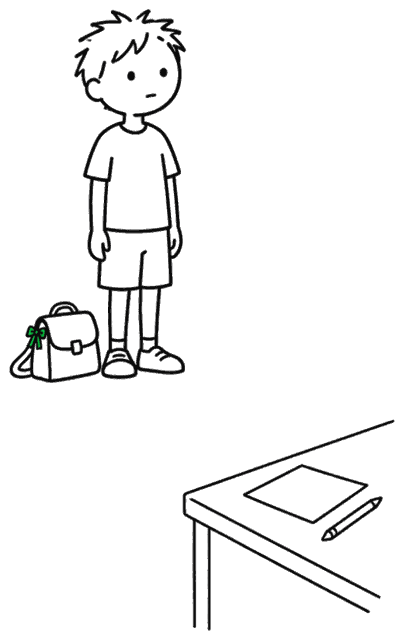
"A basketball player?"
"If that helps."
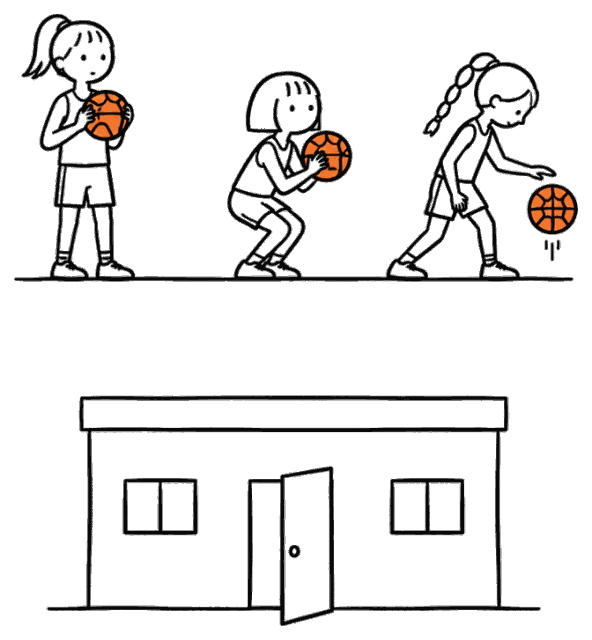
I turned over one of my game sheets and drew a player holding a ball. The figure stood upright, balanced and ready.
The boy studied it.
"That is a player waiting."
I looked again. He was right. The player was waiting for a whistle, an instruction, or permission to begin.
I tried a second time. I bent the knees, moved the ball into two hands, and drew the eyes looking toward an imaginary basket.
"That is a player who knows what to do," the boy said.
"Isn't that what learning is for?"
"Afterwards, perhaps."
I tried a third time. This player dribbled hard, head down, jaw tight, as if the ball might escape.
The boy shook his head. "He doesn't look like he loves it."
"Do you have to love it to learn it?"
His fingers found the green ribbon on his bag. He took a long time to answer.
"I don't know. That is one of the things I came to find out."
I put the pencil down. "Then you draw him."
"I can't. That is why I asked you."
There are children who become embarrassed when an adult becomes impatient. There are others who become frightened. This boy merely waited for my impatience to finish.
I tried a foot arriving half a second late, a hand reaching toward an unfamiliar pass. On the paper they looked like clumsiness. When I corrected them, the feeling of learning disappeared.
At last I drew four walls, a roof, two high windows and a door left open.
"There," I said. "The player who is learning is inside."
The boy leaned closer. His shoulders lowered a little.
"Yes," he said. "There is enough room in there to learn."
He sat on the floor beside the scorer's table.
"Shouldn't you be with your team?" I asked.
"Where is yours?"
Across town, our players were asleep in a budget hotel, trusting me to know what to do when they woke up. I turned my game notes face down.
"Is your name on a list somewhere?" I asked. "A team, a number?"
"No."
He said it the way other children say their names.
I pulled out the chair beside mine. He lifted his bag first, carefully, so its buckle would not scrape the floor, and sat down beside me.
The broken clock remained at 2:42.
That was how I met the boy with no number.
↑ The Little PlayerThe Three Hoops
The boy was still there when the cleaners arrived.
They moved around him with mops and rolling bins. He lifted his feet when they needed the floor beneath them and lowered them when they had passed. One of them asked whose he was. He said, "Nobody's, today," and she seemed to find that a reasonable answer for a tournament.
"Then why are you here?" I asked, when she had gone.
"I wanted to see how the real players learn."
"Do you want to get better?"
"I thought it might help."
He looked toward the courts. Most of their lights were still off.
"Do you have a home court?" he asked.
I thought of the courts I had borrowed for a while, rented, tried to rent, and been asked to leave. "Not one of my own."
"I do."
Little by little, his court assembled itself from the things he said. It was outdoors, behind a row of garages, made of concrete, with a fence along one side and a streetlight that came on too late in winter. It was not large and not small. A crack crossed the lines. Rain gathered in the left corner.
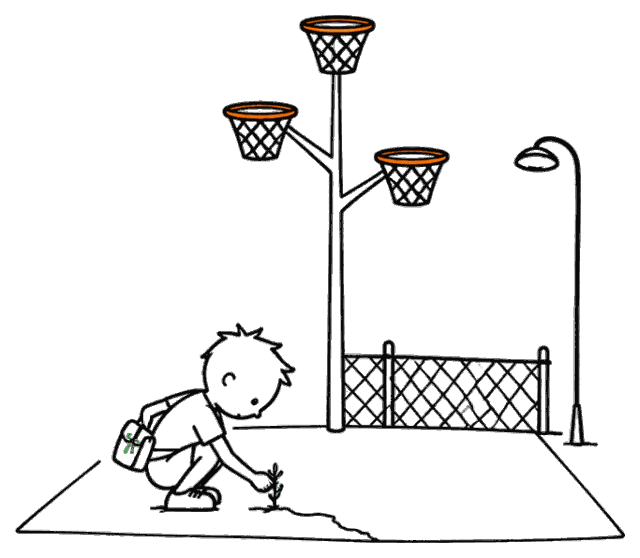
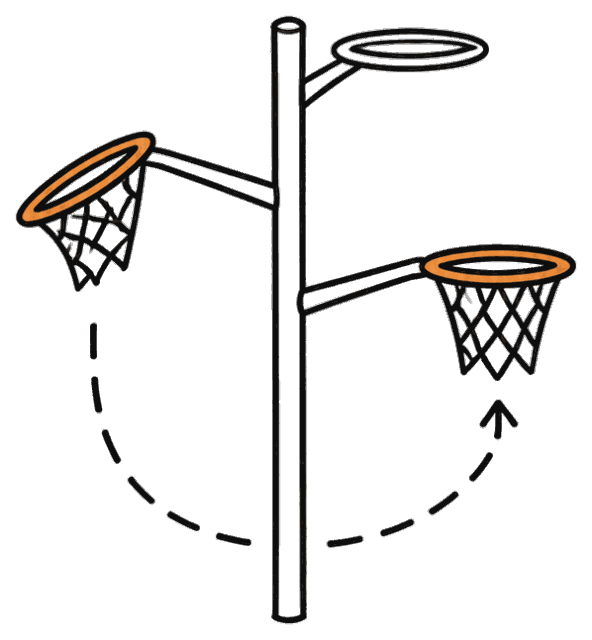
At its centre stood a single metal post. Three arms branched from it, each carrying a backboard and a hoop, each facing toward a different edge of the court.
"Who builds a court like that?"
"Somebody who could only afford one post."
From any one hoop, the place was a half-court. But to attack another basket you could not take the short way. You had to start under one hoop, run the long way round the post, past the third basket in the middle, and out to the far one. Then the half-court became a full court.
The first backboard was weathered but square. Its bare metal rim had no net at all.
"I use that one for catching," he said. "I throw the ball against the board from every angle. Without a net, I can throw it at the board from under the rim too. Only the catch matters."
The second backboard sat crooked, and its rim had been pulled down on one side. An old net hung unevenly from the warped ring.
"That one never gives the ball back the way you expect. There, it is me against the hoop, one on one. First to ten." He almost laughed. "It wins most of the time."
"Why don't you fix the rim?"
"That is the one I learn most on."
The third basket was kept true: its backboard straight, its rim round and level, and every loop of its net intact.
"I keep that one perfect so I do not forget what perfect feels like."
His fingers found the green ribbon on his bag.
"Does anyone else use that one?" I asked.
"Someone smaller. Usually she's there before I am."
His fingers stayed on the ribbon. I waited for more, but he began telling me about the crack in the court.
"Who taught you all that?"
"The hoops."
"Hoops can't teach."
"Then why do you keep putting players near them?"
I took out my notebook. He watched the pencil.
"Are you going to write down what I said?"
"I might."
"Will you try it?"
I looked past the notebook at the court, lost in thought.
He told me he walked around his court every morning before he practised. He looked for loose stones, new cracks, and weeds coming up between the lines.
"If you pull a weed when it is small, the root comes with it," he said. "If you wait, it breaks off and grows back. After a while you think it belongs there."
"Do you ever skip your morning checks?"
"Sometimes."
This answer relieved me. I had begun to wonder whether he ever forgot anything.
"What happens if you skip a day?"
"The court is still there the next day."
"A court always waits for you," he said. "That is one reason to have one."
One of the cleaners pushed a wide mop between us, erasing our footprints from the varnish.
↑ The Little PlayerWhere or When
At six, the first teams began to arrive.
Doors opened. Bags struck the floor. Balls escaped from racks and were called back. Coaches crossed the gym carrying coffee and certainty.
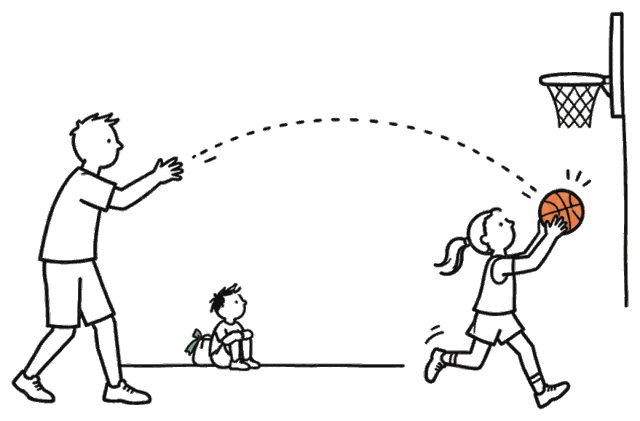
The boy watched a girl practise a cut with her father. She ran from the wing to the basket. The pass struck the wall behind her.
"Again," the father said.
She ran faster. The second pass struck her shoulder.
"You are in the wrong place."
The boy looked at me. "Is she?"
"The pass is supposed to meet her at the rim."
"I know. But is the problem where it meets her, or when?"
"What?"
"Where she goes. When the ball goes."
The girl had reached the correct place, but the ball had arrived after she did. Her father corrected her route. She made the same route more carefully. The pass was late again.
"When," I said.
The boy nodded.
I walked over before I had decided to. "May I try something?"
The father looked at my shirt, then at the ball in his hands. "Please."
I asked the girl to make the same cut. This time I told her father to release the ball the moment she crossed the three-point line. The pass met her hands beneath the basket.
Her expression did not celebrate success. It recognized it.
The father said, "That's what I've been telling her."
The girl held the ball. "You were telling me where to run."
He opened his mouth, then looked at the line she had crossed.
"Could we do that once more?" he asked me.
On the next cut he released the ball sooner. She caught it beneath the basket and brought it back to him.
I returned to the scorer's table.
"He had not been telling her that," said the boy.
"No."
"Why did he think he had?"
"Because grown-ups often remember the instruction they meant to give, not the one they actually gave."
"Do coaches do that?"
"Especially coaches."
Behind us, her father asked, "Was that better?" This time he waited for her answer.
The boy considered me more carefully after that.
"In our game yesterday," I said, "we kept focusing on where. Maybe the real question was when."
"Maybe."
"You don't sound convinced."
"I did not see the game."
It was the first time that morning anyone had declined to have an opinion about it.
I turned my notes face up. Beside SPACING I wrote TIMING.
That was the first honest mark I made all night.
↑ The Little PlayerThe Trophy Room
The tournament director found us at half past six.
He wore a headset though nobody was speaking into it. He looked at the boy, then at his clipboard.
"Name? Team? Number?"
The boy had none of the three.
"Children can't sit beside the scorer's table without a credential," said the director.
"Where can he sit?" I asked.
The director pointed toward a corridor. "Anywhere that isn't here."
So we walked.
The corridor ended at a room whose glass walls displayed trophies from previous tournaments. Cups filled the shelves. Photographs covered the remaining space. In every photograph, a winning coach stood in the centre.
Inside, a man was arranging medals into straight rows.
"You are early," he said. "Good. Winners are early."
He recognized me and asked about our loss. Before I could answer, he offered the explanation.
"They didn't want it enough."
The boy looked at the medals. "How much is enough?"
The man smiled. "More than the other team."
"How can you see wanting?"
"You see it in winning."
"Then how do you know before the game?"
The man stopped aligning medals.
I tried to rescue him. "He means players must compete."
"I know what compete means," said the boy. "I do not know how losing proves that someone wanted less."
The man picked up a gold medal and held it toward him.
"This proves it."
"What does the silver one prove?"
"That somebody came second."
"Did they want silver?"
"Nobody wants silver."
"Then wanting cannot be what decides it."
The room became very quiet for a place containing so much victory.
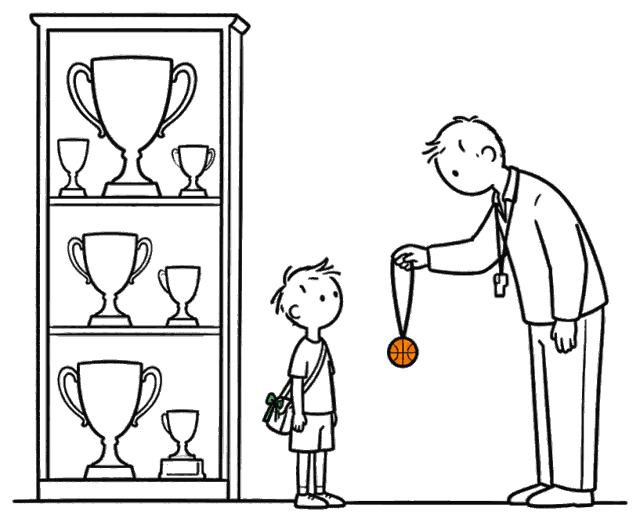
The man turned to me. "Is he with you?"
"No," I said.
The answer came too quickly. The boy looked at me, then at the medal.
The man resumed his rows. "Good. Questions like that spread."
We left the trophy room.
In the corridor the boy said, "Do you want to win today?"
"Very much."
"Then he was a little bit right?"
"A little bit."
"Which bit?"
I thought about it for longer than I expected. "Wanting matters. You just can't measure it with a medal."
He nodded. Then he said, "You could have said I was with you."
"I barely know you."
"That is true."
↑ The Little PlayerThe Video Room
The next door stood open.
Inside, six coaches watched yesterday's games on six screens. Each wore headphones. The players on them were covered in circles, arrows, angles, and coloured marks.
One coach waved me in. "We clipped your game."
He showed me a possession from the second quarter. Our guard received the ball on the wing, hesitated, and passed it back. The coach froze the image.
"Poor decision."
He gave the moment a red label.
"What should she have done?" asked the boy.
"Attacked the gap."
"Was the gap open?"
The coach rewound three seconds. "There."
"It was open before she caught the ball."
"Exactly. She was too slow."
"Could she see it?"
The coach enlarged the overhead angle. From the ceiling, everything was visible.
"Anyone can see it."
The boy pointed at the defender between our guard and the gap.
"We can see over her," he said. "Could your player?"
"She should have."
"Did anybody show her where and how to look?"
The coach didn't answer.
The boy kept his finger on the screen, on the space the defender was hiding. "Then maybe it isn't even a mistake," he said slowly. "Maybe she doesn't know how to look for gaps yet. Or she knows, and from the angle she stood at, this one couldn't be seen."
He rubbed a thumbnail along the green ribbon. "I have told someone she had to see things she couldn't see yet."
The coach did not answer. He changed the label from red to amber. It was a small change, but I noticed it.
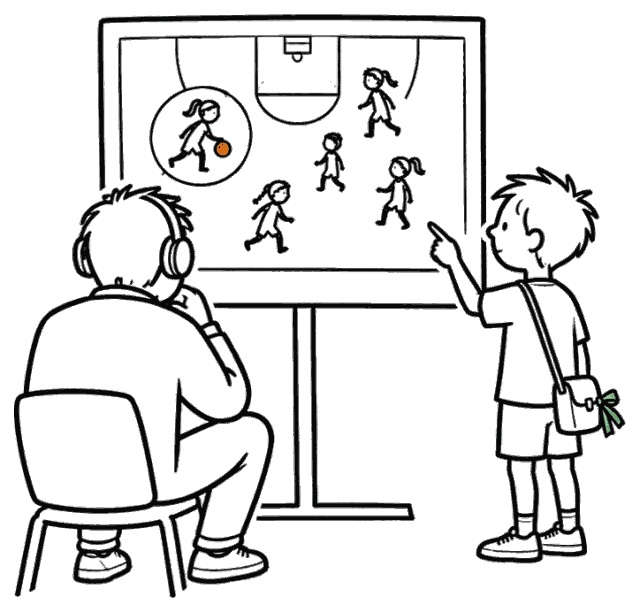
On another screen, numbers showed every pass, every shot, every run, every error from the day before: every step anyone took. The numbers were beautiful. They made the games look as if they had known all along what they meant.
"Which number helps her today?" the boy asked.
"All of them," said a second coach.
"She cannot carry all of them onto the court."
"That's why she has us."
I looked at the frozen image of my guard. At halftime I had asked her to make eleven corrections. I could recite them. I could not remember whether she had said anything.
"Did she tell you what she saw?" the boy asked me.
"No."
"Did you ask?"
"No."
He did not say anything more. He stood up and waited by the door.
Before leaving, I asked for the clip. The coach sent it to my phone with all the markings removed.
I watched it in the corridor. Without the arrows, I had to watch it three times to find the gap.
↑ The Little PlayerThe Player Who Quit
On the way back from the video room, we passed Court Five.
A game was in its last minute. At the scorer's table sat a tall boy of about seventeen with a volunteer's lanyard round his neck. He ran the clock without looking up. Beside the scoresheet lay a thick notebook with a soft, bent cover.
The boy stopped.
"He is not watching the game," he said.
"He's working."
"He is not watching that either."
The buzzer went. The teams shook hands, and the next two began to warm up. The volunteer stayed where he was. We sat down at the end of his table.
"Do you play?" the boy asked him.
"I used to."
"Why did you quit?"
"The coach didn't trust me."
"Why not?"
"Because I didn't improve."
"Why didn't you improve?"
"Because he didn't play me."
The circle was complete. I had heard versions of it many times, usually from the safe side of a desk.
The boy looked at the notebook. "What is in there?"
The older player turned it toward us. Page after page, in small, careful writing: dates, and under each date, sentences. Elbow in. Ball higher. Don't look at the bench. See the weak side. Shoot with confidence. Slow down. Faster. Some lines had been crossed out. Some had been written twice.
"Everything my coaches told me," he said. "Four years. I wrote it all down so I wouldn't forget."
"Did you forget?"
"No. That was the problem." He closed the notebook. "By the end, every time I caught the ball, all of it was in my head at once. You can't play with forty pages in your head."
"Were they wrong?"
"Most of them were right."
"Then what was wrong?"
He thought about it. "Nobody ever told me which one mattered when. And every time I tried something on my own, there was a new page."
The boy turned to me. "Have you ever made someone quit?"
The older player's notebook lay between us. I kept looking at its bent cover.
"More than once, probably," I said. "But one I'm sure of. A boy who couldn't finish a lay-up with his left hand. I thought he was good. I asked him to come in early on Saturdays, partly to teach him, partly to see if he wanted it enough."
"Did he come?" asked the older player.
"Twice. The third Saturday he didn't. He never came back to practice either."
"What did you tell yourself?"
"That he wasn't determined enough."
Nobody said anything for a while.
The boy drew his chair nearer mine. Its legs made a small complaining sound against the floor.
The boy turned back to the older player. "What else do you remember?"
The older player stared at the floor.
At last he said, "There was a pass from the corner once. I caught it without looking. The one who threw it knew where I would be. Nobody even had to say anything."
"Can you still make that catch?"
"I don't know."
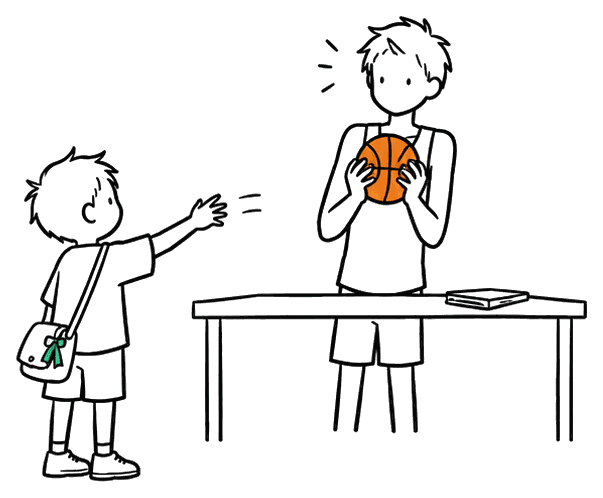
A ball from the warm-up had rolled under the table. The boy picked it up. Without warning, he passed it—not hard, but badly. The older player caught it against his chest.
"That was a terrible pass," he said.
"But you caught it."
The older player looked at the ball in his hands.
A girl from the warm-up was waving for it. He did not roll it back. He stood and passed it to her, flat and quick, and she caught it without breaking stride.
He sat down again. After a moment he put the notebook into his bag, under the table, and zipped it shut.
We left before the game began.
In the corridor I said, "You should have warned him before the pass."
"Then I would not know whether his hands remembered."
"You might have frightened him."
The boy frowned. It was the first correction of mine he did not accept easily.
"It worked," he said.
"This time. You didn't know that before you threw it."
He walked quietly after that, looking at his own hands. At the next door he waited for me to catch up.
↑ The Little PlayerFourteen Drills
At the far end of the building, a whistle sounded every twenty-four seconds.
We followed it to Court Twelve. Seven children moved through drills while a coach reset cones, fetched balls, checked his watch, and blew the whistle again.
We counted fourteen drills, thirty-five whistles, no questions, and no water.
When the session ended, the coach sat against the wall. He looked too tired to remove the whistle from his mouth.
"What problem did the seventh drill solve?" asked the boy.
The coach closed his eyes. "Which was the seventh?"
"Two lines. Catch, pivot, pass."
"We always do that one at seven fifteen."
"That is when. What is it for?"
The coach opened his eyes.
I expected him to defend himself. Instead he said, "I used to know."
He told us there had been a time when every drill carried a reason. One taught players to lift their heads and look before they thought about their hands. Another taught the second step after a stop. Another created a choice between passing and driving.
"Then the club added a curriculum," he said. "Then evaluations. Then more age groups. The explanations became shorter. There was nobody left to ask when something stopped working."
"Doing the same thing every day," said the boy. "Is that good?"
"It used to be. It's how they learned it."
"And now?"
"Now it's how I stopped thinking about it."
"Could we do the seventh one?" asked the boy.
The coach looked toward the exit. "I have another group in ten minutes."
"Then we have time for some repetitions."
They stood opposite each other. Catch, pivot, pass. Slowly.
On the fifth repetition the coach said, "Keep the pivot foot down."
On the sixth: "See the target before the catch."
On the seventh he stopped.
"That's what it was for."
For the eighth, he removed the cone that told the boy which direction to turn.
"Now choose," he said.
The boy caught, read the coach's position, and pivoted away from him.
"Better," said the coach.
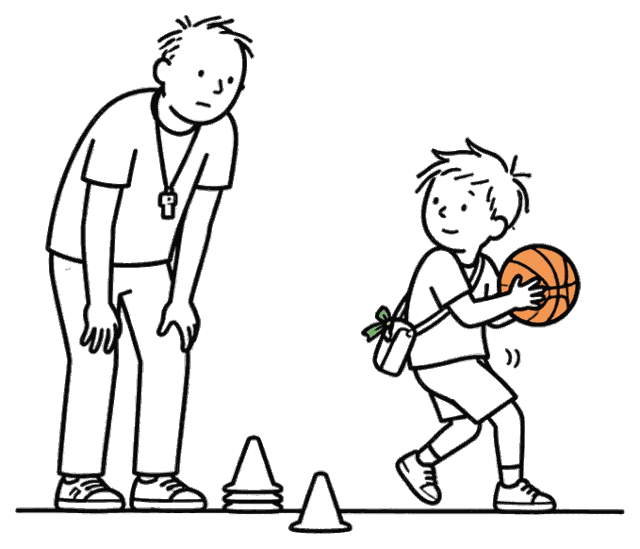
When the next group entered, the cones were still in a pile. The coach sat the children down and asked what they expected from the session.
None of them knew. He waited for an answer anyway.
As we reached the door, he called after me. "Your first drill on Monday. What is it for?"
He did not give me time to open my mouth.
"Anyway, tell me when you come to the next tournament," he said.
"I liked him," said the boy as we left.
"Why?"
"Because he wanted to remember."
"He looked tired," I said.
The boy looked back through the glass.
"Was I too hard on him?"
"I don't think so. You just helped him remember."
Behind the glass, the coach was listening to a child who had just raised her hand.
↑ The Little PlayerThe Same Shoes
By eight, the main corridor was full.
Players moved from court to court carrying identical bags. More than fifty boys passed us in five minutes. Many wore the same shoes. Many wore the same serious expression adults use when they want to look busy.
A woman with a headset directed them.
"Court Three to Court Seven. Court Eight to Court Four. Blue team upstairs. Red team across the road."
"Where are they going?" asked the boy.
"To their next game."
"And after that?"
"The next one."
"When do they stop?"
"When they lose."
Near her stood a recruiter beneath a sign that read FURTHER, FASTER. He offered assessments, rankings, travel teams, private sessions, elite camps, and a programme that promised to save a year of development.
"Which year?" asked the boy.
"The slow one," said the recruiter.
"What happens in the slow year?"
"Mostly fundamentals."
"Then why would I want to miss it?"
The recruiter handed him a brochure. On its cover, a player leapt through smoke toward a basket that could not have fit inside the photograph.
"Where do I arrive?" asked the boy.
"At the next level."
"What is there?"
"The level after that."
The boy returned the brochure.
"I think I will walk."
The recruiter had already turned toward another family.
We continued through the crowd. A team sat on a bench near the doors, laughing about something that had happened at breakfast. One player stood in the middle and imitated the way another had dropped a tray. Their laughter made an invisible, cheerful little bubble around them.
The boy watched too long.
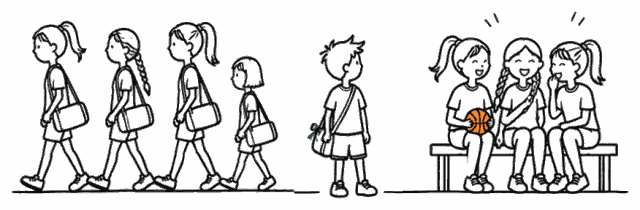
"Nia laughs like that," he said. "When she misses a shot or loses the ball, she acts the whole thing out again, from the start."
It was the first time he had said her name.
"Once her ball landed in the puddle," he said. "She gave me her bag to hold and reached for it. Her shoe came off and fell in too. So I was holding her bag and her ball, and she was fishing out her shoe."
He almost smiled. His hand opened as if it still held those things.
"You could join them," I said, nodding at the team.
"I do not know them."
"That is usually true before you join people."
"They already have enough players."
"Teams usually have room for one more."
He stopped walking and tightened his grip on the strap of his bag. I had more to say, but left it there.
"Will you sit with me until they come?" I asked.
He nodded.
We found the bench outside my locker room. He left space for me without looking up.
↑ The Little PlayerThe Bench
My team arrived at eight fifteen.
They found us on the bench outside our locker room. Tess handed me my room key, which I had left in the hotel door. Mara asked the boy to move his bag so she could sit down.
I gathered them around the blank screen in the video room.
"Yesterday I gave you too many answers," I said. "Today I have only two questions."
Tess, our captain, folded her arms. "Yesterday you had eleven answers. Now you want ours?"
"Yes."
She did not unfold her arms.
I played the unmarked clip of our guard on the wing.
"Mara, what did you see?"
Mara looked at me to find out whether this was a test.
"Their tall one was up high. I thought the gap would close."
"What did you need?"
"The pass sooner. Or Liv cutting later. We arrived together."
Where and when.
Liv leaned forward. "I thought I was late."
"You were early," Mara said.
We watched again. As we looked at it from different angles, the decisions took different shapes.
For twenty minutes the players spoke more than I did. Their explanations were very untidy. They contradicted themselves many times, but in the end they found a problem my three pages of notes had missed, one that had been right in front of us. Near the end, Tess said, "Their tall one always steps up when we swing it to the other side." Then she looked annoyed that she had said it.
Then Mara noticed the boy.
"Is he training with us?"
I looked at him. I remembered the trophy room.
"He's with me," I said.
The boy looked down.
"Can he play?" Mara asked.
"I can," he said.
"Good. We're nine."
On the court we played three against three on one basket. Mara proposed that a basket only count if all three players had touched the ball. The others agreed to try it.
The boy moved beautifully without the ball. He stopped on balance, saw space early, and caught every difficult pass.
But whenever he received the ball, he froze.
He examined every option until it disappeared.
"Move it!" Mara called.
He made the safe pass back to where it had come from.
The next possession was the same. He could find the gap. Letting someone else have the ball was harder.
I stopped play.
"What do you see?" I asked him.
"Many things."
"Choose one."
"What if it is wrong?"
"Then we'll fix it together," said Mara.
"I am not sure yet."
"You saw Liv start," I said. "Try the pass when she goes. We'll look at what happened."
On the next possession, he caught at the top. Liv cut. He passed, and Liv's defender was already in the lane. She tipped it away.
"Again," Liv said.
The second time, the defender didn't even look at Liv. She was sure the pass was coming.
Mara stopped the ball. "She's not guarding you. She's guarding your pass. You never go to the basket, so she doesn't have to worry about you."
The boy looked at the basket as if someone had moved it closer.
Liv pointed at the painted arc under the rim. "If you can put two eyes in there, it smiles at you. That's Smiley. Try to reach it. Make her come and stop you."
The next time, he drove: two steps toward Smiley. Liv's defender left her to stop him. He passed. The ball met Liv in stride. Liv laid it in and pointed at him. Tess caught the ball beneath the net and brought it back out.
For the first time, the boy smiled without trying to hide it.
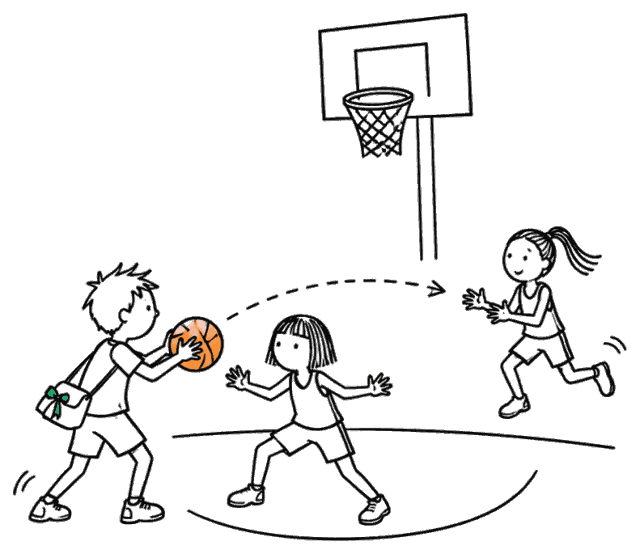
For the last few minutes we took away the rule about three touches. Liv still showed him her hands when she started to move. He was still trying to find the right moment for the pass. Once, when nobody stepped up to him, he kept it and scored himself. Nobody had told him to.
Tess's next pass sent Mara into the open space. She asked for the ball back on the following possession. Mara gave it to her.
When we stopped, the boy sat beside me to retie his shoe. I moved my foot out of his way. He finished the knot and stayed there.
↑ The Little PlayerThe Game
At halftime we were losing by eleven.
The old version of me entered the locker room first. She carried the stat sheet, adjustments, matchups, and a speech about urgency. She was ready to fill every silence before the players could even hear themselves think.
I let her wait outside.
"Is our problem time or space?" I asked.
Mara answered first. "Time. We're seeing it, but the ball arrives after the help recovers."
"What can we change?"
The players argued. Hanna wanted more drives: if we got into the paint, the help would have to decide early. Tess wanted the corners filled, so the help had further to run and we had space to use. Somebody wanted fewer dribbles and more cuts. Liv said we were cutting because the pattern told us to, not because the space was there.
"Then stop trying to run the pattern," I said.
My assistant stared at me. "We spent our last three practices on it."
"What do we run?"
"What we see," said Liv. "What they give us."
"So the three practices were for nothing?"
"No," said Mara. "That's how we know what we're looking at."
The boy sat at the end of the bench in a spare warm-up shirt. Tournament rules would not let him play. He watched every possession as if he were in it.
In the third quarter we made mistakes faster. Mara drove into a wall of help. Liv cut too soon. Hanna passed to a space nobody had chosen yet.
I nearly called timeout.
Then they began to adjust.
The passes moved earlier. The cuts waited. The corners filled. When a shot went up, all five went after the rebound. When we got it, everyone ran, even Hanna, who hated running. A missed shot, rebounded, became an extra pass and a better shot. The bench started naming what it saw.
"Corner empty."
"Help's there."
"Extra."
Hanna's pass went into the third row.
"I hadn't gone yet," Liv called.
Hanna nodded and ran back on defence.
Midway through the fourth, Mara stepped in front of a driver and set her feet. The driver ran straight through her. The whistle went against Mara.
The referee was perhaps sixteen. He had been behind the play.
Mara spun toward him, furious. I stood up.
"I thought you were there," I told her. "We'll ask him at the break. Keep playing."
She kept staring at the referee.
"Crooked hoop," said the boy from the end of the bench.
Mara looked at him, not understanding what he meant. She let out a breath and ran back on defence.
Two possessions later, the same driver came again. This time Mara was there a step earlier, square and still, where even a referee behind the play could see her. The whistle went the other way.
On the next possession she reached a loose ball first. When the girl chasing it stumbled beside her, Mara reached down and helped her back to her feet.
With ten seconds left, we were down by one.
I called timeout.
The players looked at me.
"What do you see?" I asked.
Nobody answered at once. Then the boy leaned forward.
"When Mara lifts the ball, where does their tall one look?"
"At the ball," said Liv. "Always at the ball."
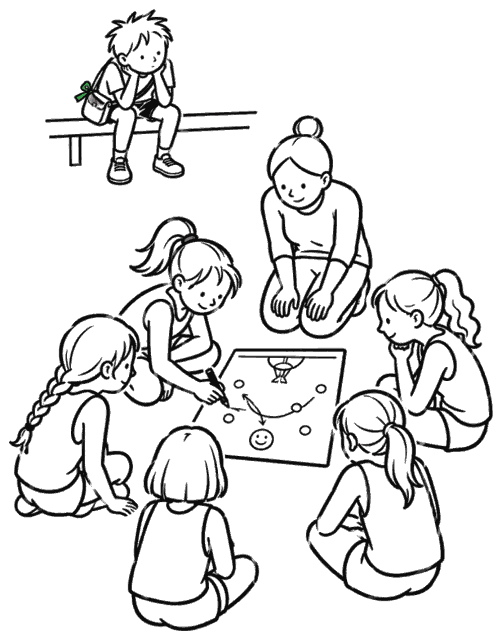
Liv took the marker from my hand and put two dots inside the little arc beneath the basket. They made a smiling face. The boy smiled back at it.
"Smiley," said Liv.
She drew five small circles, spreading them wide, with one in each corner. Then an arrow through the gap toward Smiley.
Mara pointed at it. "I can get there."
"And if they come to stop me?" Mara asked.
Liv drew a line back out to the corner. "Then I'm here."
The others leaned in. Tess moved one circle wider. Hanna rubbed out a line that crossed Mara's path. Liv put herself in the corner and tapped the board twice.
"And if we miss the shot?" my assistant asked.
"Then we miss the shot," said Mara.
Mara drove toward Smiley. Their tall one came across to stop her. Liv stayed wide and showed her hands for the pass, and it reached her before the defender could get back.
She caught, set her feet, and shot.
The ball rolled around the rim and came out. Tess reached for the rebound. The buzzer sounded before she could get it back up.
We lost by one.
For several seconds nobody moved.
Liv sat down and pulled the laces of one shoe loose. Her hands were shaking a little. Tess sat beside her without speaking.
Then Liv pointed at Mara. "That was the right pass."
"I still wanted it to go in," she added.
"So did I," said Mara.
The boy looked at Liv. "Next time?"
"Next time," she said.
In the handshake line, the other coach held my hand a moment longer than usual. "You changed something at halftime," she said. "I still can't tell whether it made us worse or you better."
The boy waited by the tunnel.
"Do you think we learned something?" I asked him.
"You will know if it is still there tomorrow."
↑ The Little PlayerThe Work Beneath the Floor
After the game, the boy gave his borrowed shirt back to Mara. A ball rolled beneath the lowest bleacher.
The boy went in after it. We heard him call from the darkness.
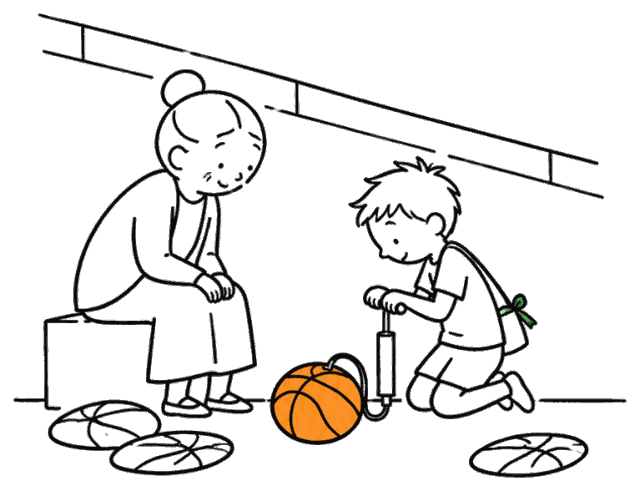
Behind the folded seats was a narrow service space filled with dust, old tape, and objects lost over many seasons: a red sock, two water bottles, a whistle, a child's glasses, and dozens of basketballs gone soft.
The tournament caretaker appeared with a hand pump.
"After every tournament," she said, "I collect what the building has swallowed."
She tested each ball. Some held air. Some leaked around the valve. One had split along a seam.
"Why repair them?" asked the boy. "There are new ones upstairs."
"Upstairs always thinks there are new ones. Down here, we know how many."
She handed him the pump.
He worked until the first ball became round beneath his hands. The task was slow. Nothing about it looked like improving or learning.
"Who sees you do this?" he asked.
"Usually nobody."
"Then how do they know it matters?"
"They don't. They bounce the ball tomorrow."
He pumped another.
While he pumped, I stacked the balls that held air. My shoulders began to ache pleasantly. Above us, games continued. Shoes squeaked. Whistles sounded.
The caretaker bent and picked something out of the dust. A green ribbon.
"Yours?"
The boy felt the zipper of his bag. The knot had come loose while he crawled.
"It's Nia's," he said.
He did not tie it back on. He held it flat against his palm.
Her name was Nia, he told us. She was eight and lived near his court. In the evenings she practised beneath the perfect hoop because it was the only one she could reach. He rebounded for her. She counted makes.
"Sometimes she came before me, sat on the ball and waited for me. She said that was how she reserved it."
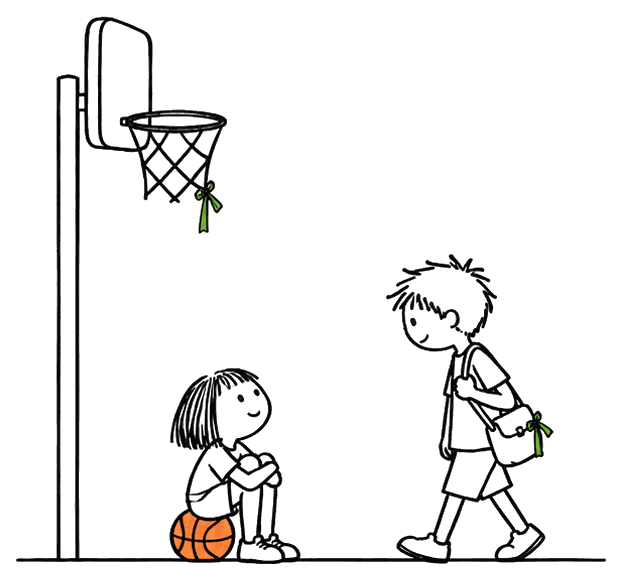
He put the ribbon across his knee.
"She tied this to the net so everyone would know which hoop was hers. Once she asked me to watch a shot. I was pulling weeds. She waited until I put the fork down."
"Did it go in?"
"No. She said I wasn't watching properly."
He smiled a little, then picked up the pump again.
"I helped with her feet. Then her hands. Sometimes she asked. After a while I didn't wait for her to ask."
"What did she do?"
"Sometimes she tried it. Sometimes she held the ball until I stopped talking. I thought she was listening."
He wanted her to love the game. He had begun to decide what that love should look like.
Then the older children had started coming on Sunday evenings. At six they played on the other two hoops until the streetlight came on.
"The last time I came, she was already playing with them. I had brought her small ball. She waved, but she didn't come over."
He turned the ribbon over.
"I called her. She said I could play too. I told her she was not ready for them. She lost the ball every time they came near her."
He pressed the pump between his knees.
"I kept telling her where to stand. She told me to stop. Then she missed a shot, and I told her about her feet again."
"What did she say?"
"That I kept the perfect hoop for myself. She pulled this off the net and put it in my hand. She said, 'Keep your perfect hoop.'"
"But you kept it for her."
"Yes."
Above us, someone dropped a ball. We listened to it bounce several times.
"I asked when she wanted to practise. She said she could practise alone."
He laid the pump down.
"I still had her ball in my hands."
The caretaker took the filled ball and bounced it once. The sound was louder down there.
"So I came here," he said. "To see how players learn. And coaches."
The caretaker gave the ball back to him and went on testing valves.
"Could I take this one?" he asked.
"Yes. Bring it back if the valve starts leaking."
The boy tied the ribbon back through the zipper, twice, and pulled the knot tight.
We carried the good balls upstairs. On the last trip he took one from my pile. We came up slowly, and neither of us said much.
↑ The Little PlayerThe Return Pass
By evening the tournament gym had emptied.
My team had gone back to the hotel. The caretaker was switching off the courts one bank of lights at a time, starting from the far end. Somebody had fixed the clock behind the scorer's table during the day. It said ten past five.
The boy looked at the clock.
"Is there still a bus?"
I checked the timetable on my phone. There was one more.
"Tomorrow is Sunday," he said. "The big ones come at six."
I had been thinking we might stay on Court One until the caretaker needed to lock up.
"Will Nia be there?"
"She usually comes before me."
He pulled the strap of his bag over his shoulder. The repaired ball was tucked beneath his other arm.
We found our way out as the last bank of lights went dark.
Outside, team buses moved along the far side of the car park. He opened his bag. Inside were a small ball and a hand fork for pulling weeds from cracks. He placed my first drawing—the gym with its door left open—between them.
"I haven't finished it," I said.
"That is why I want it."
Then he untied the ribbon from the zipper and wound it around two fingers.
"Will you tie it back on the perfect hoop?"
"I will give it to her. She can tie it where she wants to play."
He pointed to the bus stop across the road. We crossed together.
"I haven't told her I'm sorry," he said.
We sat on the bench in the shelter. The ball rested against his shoes. In the glass, our reflections sat beside us, a little darker and further away.
The bus was late. Neither of us complained.
We sat a while longer. Across the road a court's lights came on, one after another. He leaned forward to see whether anyone was there.
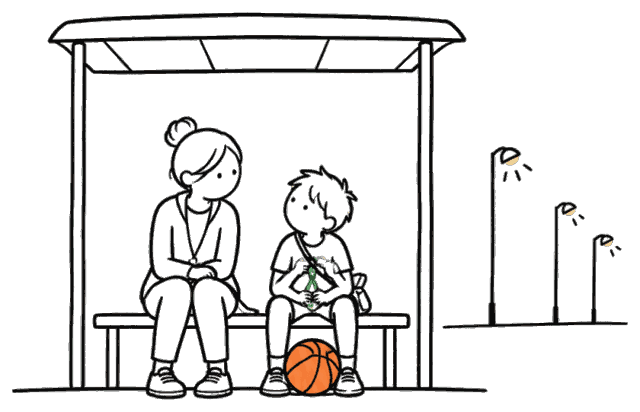
"When you see a small court lit up at night," he said, "you won't know if it's mine."
"No."
He smoothed the ribbon with his thumb.
"I don't know if she'll wait."
I stayed beside him. There was nothing on the road yet.
The bus came round the corner.
He picked up the ball. I reached for his bag before remembering it was his. He let me carry it to the door.
"Will you come back?" I asked.
"I don't know."
The answer was small and quite ordinary. I had no useful reply.
He took the bag. At the top step he turned and lifted his hand. I lifted mine.
He chose a seat beside the window and put the ball on his knees. As the bus pulled away, he lifted both hands to the glass, open, the way Liv showed hers before she cut.
I returned the pass.
After the bus had gone, I stayed until the shelter's glass held only my reflection.
For a while, whenever I turned a game sheet over, I expected a voice at my elbow.
On evenings when I pass a court with its lights on, I stop. I look for a boy waiting for someone else's impatience to finish. Sometimes there is only a caretaker locking up. Sometimes I hear a ball long before I can see who is playing.
I do not know what Nia said when he came home. I have tried to imagine it, but knowing only one side of the story has not helped.
I have continued trying to draw the player who is learning.
Every version is unfinished. In every one, I leave the door a little more open.
↑ The Little Player